top of page
Peggy Notebaert Nature Museum Experience
The research and development that went behind the Peggy Notebaert Nature Museum's new exhibit and experience.

Project Description
My team and I were tasked with a monumental task: research, prototype, test, and design an interactive, educational, and engaging experience for the Peggy Notebaert Nature Museum in Chicago, IL.
Time
January 2025 - June 2025
Skills
-
Usability Testing
-
UX Research
-
UX Design
-
Prototyping
-
Figma
-
Unity
-
Project Management
Roles
-
Lead UX Designer
-
Lead Art Developer
-
Project Lead

The Idea
The idea I came up with at the beginning of the project was simple: a 2D interactive video game where players would navigate a household with a moveable character sprite.
The goal was to combine fun gameplay with environmental education that the player would be able to apply to their daily life.
As players explore the home, they would interact with everyday household items to complete energy-saving tasks—like turning off lights or adjusting appliances.
Each interaction would reveal a fun energy fact, teaching players how small actions can reduce energy use.
The game would progress room by room, unlocking new spaces after all tasks are completed
Concepting and Initial Designs
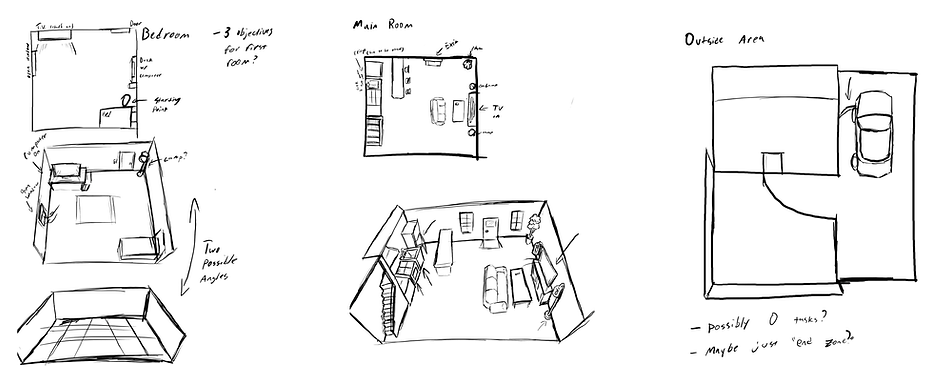
In order to bring this vision to life, a lot of time was put into the concept art and ideation. This included mood board creation, multiple rounds of ideation, research into other games with similar art styles, and rough sketches drawn by hand.


User Flows and Mapping Interactivity
In order for our experience to work, I had to be on top of everything. This included mapping out all of the key gameplay experiences to ensure nothing was falling through the cracks.
I recognized early on that in order to fully realize the vision I had for this game, a user flow/ interactivity map would be essential.
This map would serve not only as a guide for our development, but also as a check list of sorts.
Art Development and Establishing a style
Early on into the development of the game, I realized that the best way to proceed with the art development would be to establish an isometric design language.
This not only opened doors for the project on the art side of things, but also the Unity/ development side as well. Unity was the main software used to bring this game to life and fortunately, Unity make isometric game design simple.
As the lead art designer, I created numerous pixel-art sprite sheets. These included everything from interactable assets to even environmental objects and tilemap blocks.

Usability Testing
In order to ensure our game was experienced in the way it was originally envisioned, my team and I spent numerous hours at the museum testing, iterating, retesting, and so on.
Upon our first few tests, we were fortunate enough to discover that the game was running nearly perfectly, though there were a few notable issues that needed to be addressed.
1.) Some of the interactable hitboxes were too small, so it took multiple attempts for the user to click on it and activate the intended result.
2.) We realized that one of our assets - a car - looked like it was interactable so users continued to try and tap it, leaving them confused as to why it didn't work. The solution to this was simple: make it interactable.
Final Design and Outcomes
After 22 weeks of development, I was able to lead my team to create a deliverable that met all of the of the requirements of the Nature Museum.
The game has had insanely positive reviews over the time it has been apart of the exhibit, and people really enjoy engaging with the experience, which was the best outcome I could've hoped for.


Reflection
If I could go back in time, back to the beginning of this project, there are a few things I would've done differently:
1.) I would've done a lot more user testing at the museum and outside of the museum.
2.) I would've kickstarted the Unity development earlier than I did.
3.) Conduct way more rounds of user testing if time allowed.
Reflecting on this project, there were a handful of opportunities where I think "what if I did just a bit more." Unfortunately, the reality of the situation is that my team had a limited amount of time and resources compared to others in the exhibit. The four of us were able to put together a great experience in the time we were given. Sure, a few more weeks of production would have been great, but that's not always realistic. You just have to do what you can with the time that's given to you.
bottom of page